











 首页
首页科研成果

论文
Morphology-Based Evaluation of Pollen Fertility and Storage Characteristics in Male Actinidia arguta Germplasm
作者:Hongyan Qin, Shutian Fan, Ying Zhao, Peilei Xu, Xiuling Chen, Jiaqi Li, Yiming Yang, Yanli Wang, Yue Wang, Changyu Li , Yingxue Liu, Baoxiang Zhang, and Wenpeng Lu
刊物名称:Plants
发表年月:2025年8月
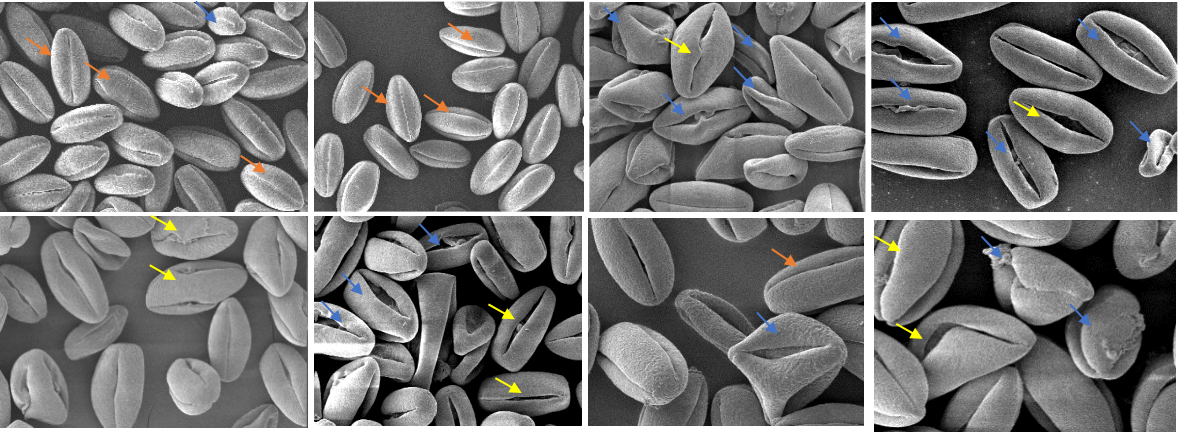
摘要内容:Actinidia arguta is a dioecious plant, and the selection of superior male germplasm is crucial for ensuring effective pollination of female cultivars, maximizing their economic traits, and achieving high-quality yields. This study evaluated 30 male germplasms for pollen quantity, germination capacity, storage characteristics, and ultrastructural features. Results revealed significant variation in pollen germination rates (1.56–96.57%) among germplasms, with ‘Lvwang’, ‘TL20083’, and ‘TG06023’ performing best (all >90% germination). The storage characteristics study demonstrated that −80 ◦C is the optimal temperature for long-term pollen storage in A. arguta. Significant variations were observed in storage tolerance among different germplasms. Among them, Lvwang exhibited the best performance, maintaining a germination rate of 97.40% after 12 months of storage at −80 ◦C with no significant difference from the initial value, followed by TT07063. Pollen morphology was closely correlated with fertility. High-fertility pollen grains typically exhibited standard prolate or ultra-prolate shapes, featuring a tri-lobed polar view and an elliptical equatorial view, with neat germination furrows and clean surfaces. In contrast, low-fertility pollen grains frequently appeared shrunken and deformed, with widened germination furrows and visible exudates. Based on these findings, the following recommendations are proposed: 1 Prioritize the use of germplasms with pollen germination rates >80% as pollinizers; 2 Establish a rapid screening system based on pollen morphological characteristics. This study provides important scientific basis for both male germplasm selection and efficient cultivation practices in A. arguta (kiwiberry).
文章关键图片
原文链接:https://www.mdpi.com/2223-7747/14/15/2366