



 首页
首页科研成果

论文
Cellular osmoregulation enhances porcine embryo development by restoring zygotic genome activation via metabolic–epigenetic crosstalk
作者:赵向远1、刘理想1、褚萧宇1、张颖、唐毓、邵静、范冰峰、杨镒峰、许保增*
刊物名称:Cellular & Molecular Biology Letters
发表年月:2025.11.13
摘要内容:
Abstract
Introduction
In vitro embryo culture is essential for human assisted reproduction and livestock breeding, yet its efficiency remains limited owing to developmental arrest triggered by suboptimal media composition and environmental stressors. Preimplantation embryos are highly sensitive to a minor increase in osmolarity under organic osmolyte deficiency, which disrupts cell volume homeostasis to cause developmental block. However, the osmosensing mechanisms and the causal link between volume dysregulation and developmental arrest remain undefined. Elucidating these mechanisms will identify targeted osmoregulatory interventions to enhance in vitro culture efficiency.
Methods
This study established a porcine two-cell embryo developmental arrest model under physiological-range hyperosmotic stress (330 mOsm) and organic osmolyte deficiency, which disrupts cell volume homeostasis. Through single-embryo RNA-seq, Real-time quantitative polymerase chain reaction (RT-qPCR), H3K4me3/H3K27ac/H3K9me3/m6A/BrdU immunofluorescence, mitochondrial assays (MitoTracker Red and reactive oxygen species (ROS) staining), and metabolic analysis (pyruvate dehydrogenase (PDH) activity by Western blotting, fatty acid oxidation by FAOBlue staining), we identified hyperosmosis-induced developmental impairments. Rescue experiments via organic osmolyte supplementation, PDH modulation, and epigenetic interventions further defined the molecular basis of embryonic arrest.
Results
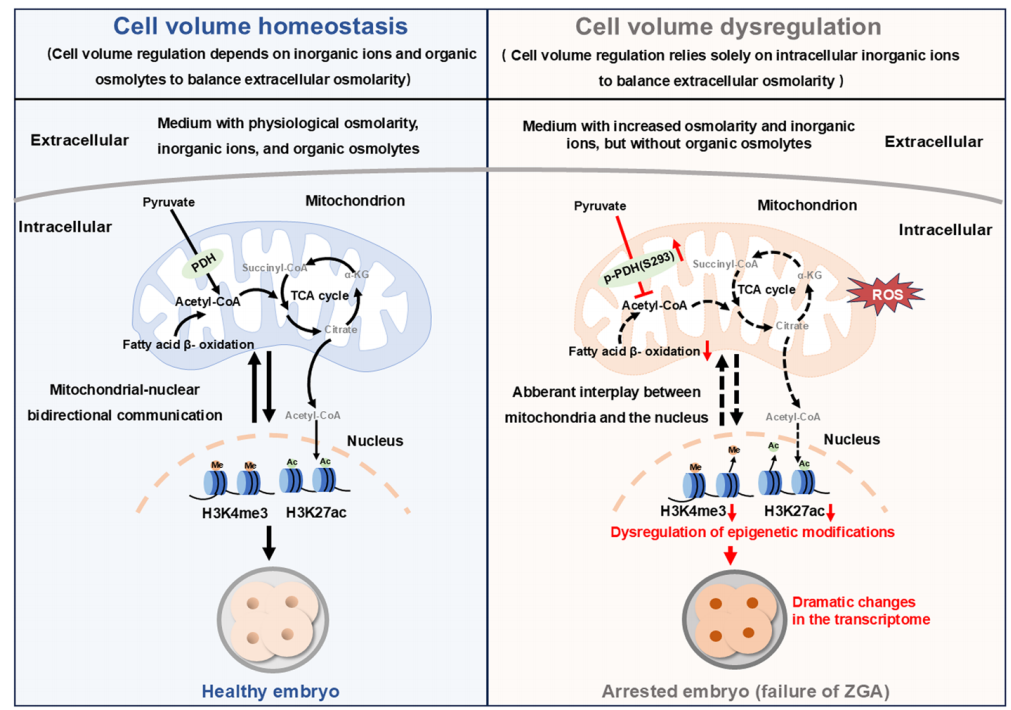
Here, we reveal that physiological-range hyperosmolarity in the absence of organic osmolytes disrupts cell volume homeostasis in porcine two-cell embryos, triggering developmental arrest at the S phase of the four-cell stage. This arrest coincides with aberrant maternal-to-zygotic transition, characterized by impaired maternal transcript degradation, compromised zygotic genome activation (ZGA), and coordinated dysregulation of nuclear and mitochondrial DNA transcription. Mechanistically, arrested embryos exhibit disrupted metabolic–epigenetic crosstalk, including PDH inactivation via S293 p-PDH accumulation that blocks pyruvate-to-acetyl-coenzyme A (CoA) conversion, fatty acid β-oxidation inhibition, alongside elevated mitochondrial membrane potential (MMP), increased ROS accumulation, and reduced H3K4me3 and H3K27ac modifications. Critically, while pharmacological modulation of H3K4me3/H3K27ac fails to rescue developmental defects, restoring volume homeostasis with organic osmolytes (e.g., glycine/betaine) or reactivating PDH via dichloroacetate (DCA) treatment completely reverses hyperosmotic stress-induced developmental arrest.
Conclusions
These findings identify that mitochondria in porcine preimplantation embryos act as osmotic stress sensors. Under conditions of extracellular organic osmolyte deficiency and elevated osmolarity, they drive metabolic reprogramming and nuclear epigenetic dysregulation, ultimately disrupting mitochondrial–nuclear communication, compromising ZGA, and inducing developmental arrest. These findings provide mechanistic insights for optimizing in vitro culture systems in reproductive technologies.
文章关键图片
原文链接: DOI: 10.1186/s11658-025-00826-3.