



-

本所概况
中国农业科学院特产研究所(简称特产所)建于 1956 年,是全国唯一的专门从事特种经济动植物资源保护、开发与利用的国家级综合性农业科研机构,也是中国农科院在吉林省的唯一直属单位,主要研究对象为珍贵、稀有、经济价值高的特种经济动植物。
-

机构设置
本所构建了分工清晰、运转高效的组织体系,下设创新团队、支撑部门、职能部门与所办企业四大板块,其中创新团队主攻科研攻关,支撑部门提供技术保障,职能部门负责行政管理,所办企业推动成果转化。
-

科技创新
本所持续完善科研创新体系,稳步建设各级科研平台,聚力开展特种经济动植物领域基础研究与技术攻关,为产业发展提供坚实科技支撑,全面提升核心科研竞争力。
-

人才队伍
-

成果转化
-

学会刊物
特产学会与特种经济动物兽医分会搭建行业学术交流网络,《特产研究》《特种经济动植物》专注刊载特种经济动植物科研成果,汇聚科研力量,传播前沿技术,为产业发展搭建高水平学术阵地。
-

研究生教育
-

党建文化
 首页
首页科研成果

论文
Changes in Endogenous Hormones and Protective Enzymes in Hardy Kiwifruit (Actinidia arguta) In Response to Bacterial Canker (Psa) Infection
作者:秦红艳,陈秀灵,赵滢,许培磊,张宝香,王月,范书田,李嘉琪,刘迎雪,李昌禹,路文鹏,艾军,杨义明
刊物名称:International Journal of Fruit Science
发表年月:2026年1月
摘要内容:The present study investigated changes in endogenous hormones and protective enzyme activities in response to Psa (biovar 2) infection in resistant and susceptible accessions of Actinidia arguta. The resistant accession “Cuiyu” and susceptible accession “TL02062” were inoculated with Psa “R12.” The activities of superoxide dismutase (SOD), catalase (CAT), peroxidase (POD), phenylalanine ammonia-lyase (PAL), and polyphenol oxidase (PPO), as well as contents of salicylic acid (SA), jasmonic acid (JA), total phenolic, and lignin in plant stems at days 0 (CK), 2, 7, and 14 after inoculation were assessed. After inoculation, the activities of SOD, POD, PAL, and PPO in both resistant and susceptible accessions were significantly increased. The JA content in resistant accessions increased, while that in the susceptible accessions first decreased and then increased. The total phenolic contents of resistant accessions were higher than those of susceptible accessions. The SA content was positively correlated with the JA content and with PAL and POD activities. Lignin content was negatively correlated with the levels of SA, JA, and the activities of PAL and POD. The disease resistance of A. arguta is significant correlations with the levels of SA and JA, as well as the accumulation of polyphenolic compounds. This research indicates that SA and PAL play a pivotal role in regulating the defense responses of A. arguta against Psa infection. By comparing the differential physiological responses of resistant and susceptible accessions to Psa “R12,” this study provides novel theoretical insights into the physiological and biochemical mechanisms underlying disease resistance in A. arguta, offering valuable references for guiding disease-resistant breeding programs.
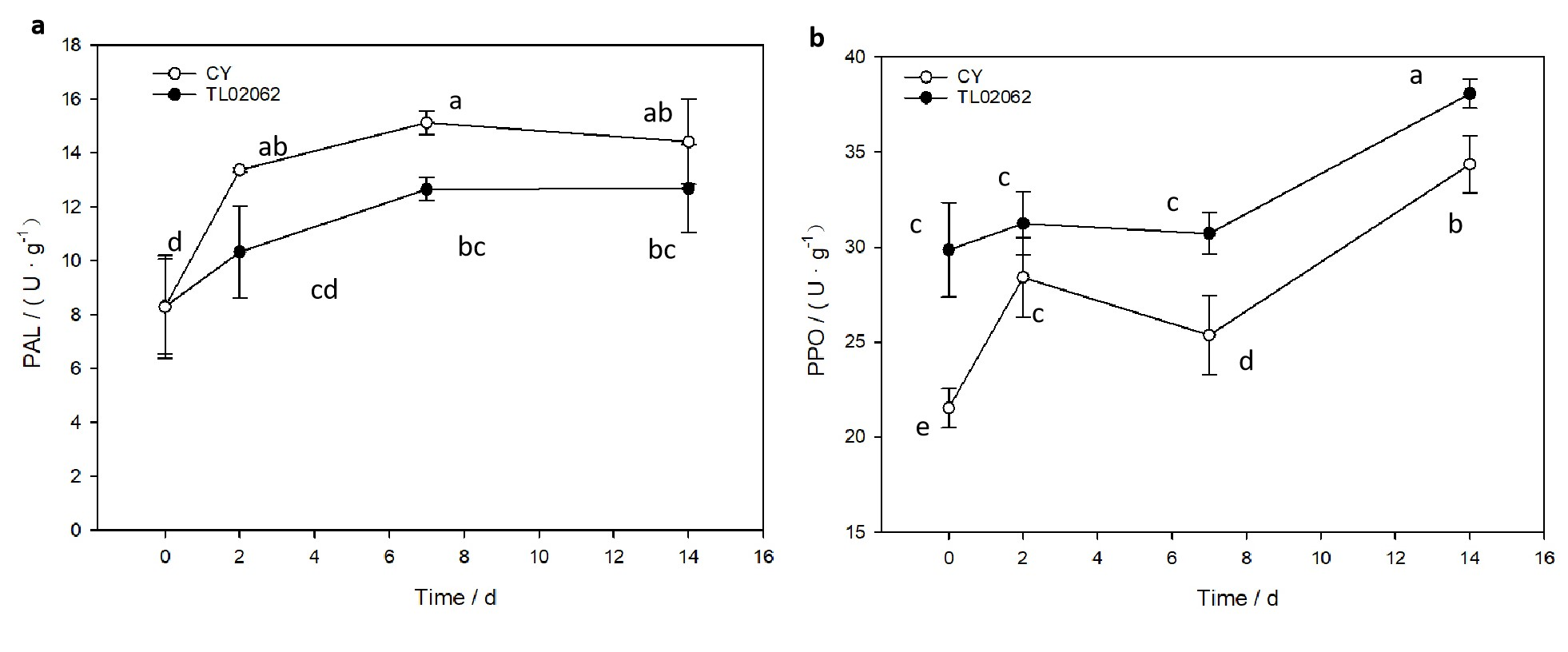
Figure 1. Changes in (a) phenylalanine ammonia lyase (pal) and (b) polyphenol oxidase (PPO) activities in A. arguta stems before and after Psa inoculation. 0–14 days post inoculation (dpi) with Pseudomonas syringae pv. actinidiae (Psa) biovar 2. Enzyme activity is expressed as units (u) per gram of stem tissue. Error bars show standard error of the mean. Treatments with different lettering are statistically different, as indicated by least significant difference (LSD, p < .05). b shows that PPO activity in both “CY” and “TL02062” increased following inoculation. Prior to inoculation, resistant “CY” showed significantly lower PPO activity (21.53 U·g−1) than susceptible “TL02062” (29.86 U·g−1). By 2 dpi, “CY” exhibited rapid PPO activation (28.40 U·g−1, 1.32-fold increase versus control) (). In contrast, “TL02062” showed no significant PPO increase until 14 dpi (p < .05).
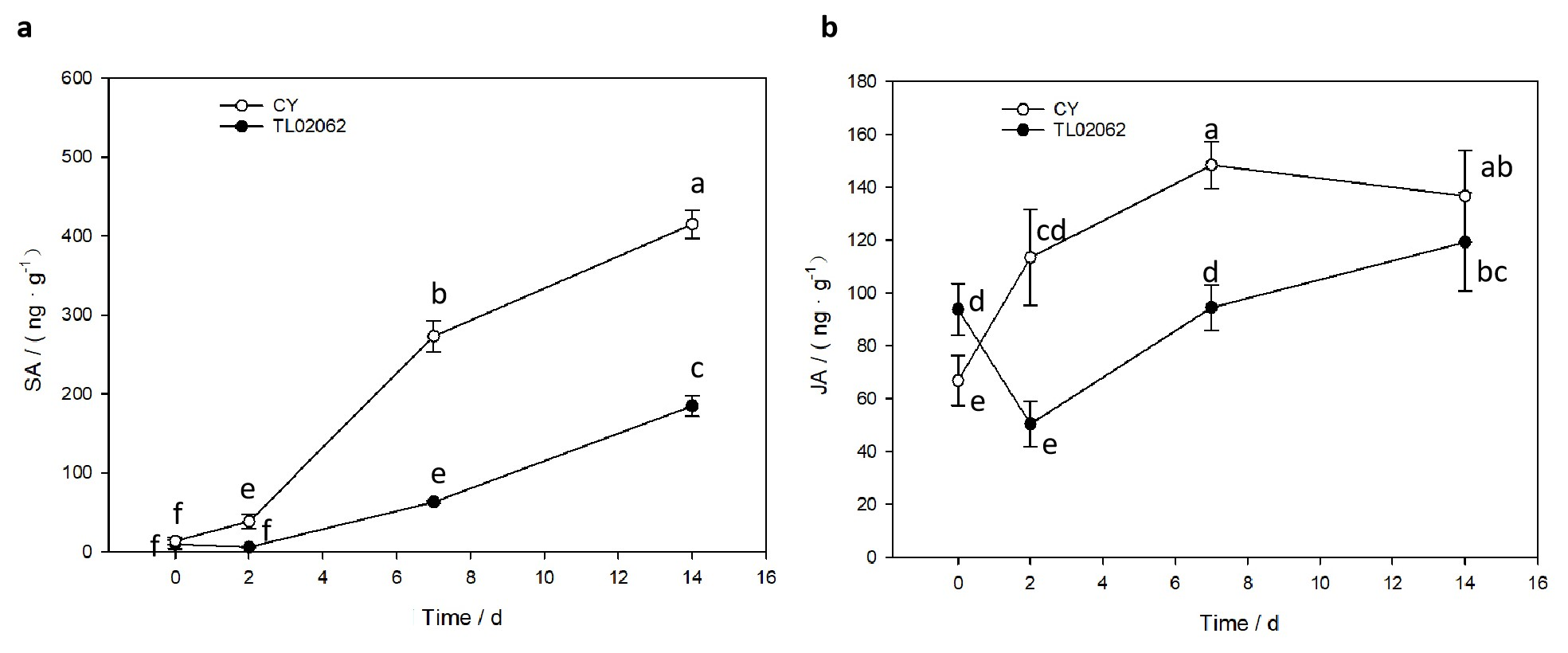
Figure2. Changes in endogenous (a) salicylic acid (SA) and (b) jasmonic acid (JA) contents in A. arguta stems before and after Psa inoculation. 0–14 days post inoculation (dpi) with Pseudomonas syringae pv. actinidiae (Psa) biovar 2. Error bars show standard error of the mean. Treatments with different lettering are statistically different, as indicated by least significant difference (LSD, p < .05). In resistant “CY,” JA content increased significantly (p < .05) at 2, 7, and 14 dpi, peaking at 148.44 ng·g−1 (2.2-fold control) by 7 dpi). Susceptible “TL02062” showed initial JA reduction (53.7% decrease at 2 dpi) followed by significant increase (p < .05) to 119.26 ng·g−1 (1.27-fold control) by 14